
The Engage Approach
A whole-system approach to addressing domestic abuse, focused on safety, accountability and lasting change.

Developed from survivor feedback, the Engage approach keeps adults and child victims safe by holding perpetrators to account.
Our Engage training programmes are based on our ‘Age, Stage & Phase’ approach, meaning support is available for anyone impacted by domestic abuse, at any time.
The programmes can be offered independently or integrated into existing services.
The scale of the problem
1 in 4
women
1 in 6
men
1 in 2
trans people*
Will be the victims of domestic abuse in their lifetime
*we do not know or have an estimate of how many people use harmful behaviour in their relationship and/or family.
The cause of the problem
We know domestic abuse is caused by people using harmful behaviour towards intimate partners and family members. And for over 50 years, we have focused our efforts on making adult and child victims of domestic abuse safe. Despite this, the statistics have barely changed.

Two women are killed every week
by partners or ex-partners. Three are estimated to die by suicide as a result of domestic abuse.
Two men are killed each month
and we do not even have a way to estimate how many men die by suicide as a result of domestic abuse. This is despite the fact that over 75% of 6,588 suicides in 2023 were male.
The current response –
Criminal Justice
Works with the perpetrator to punish harmful behaviour. Around 2% of arrests end in conviction.
Use of bail to protect victims and children. Breaches of bail are high and the main reason victims recant
Breaches of bail receive little intervention
Engage: a new response
Criminal Justice
Contact with a behaviour change worker at the point of arrest.
Bail Support to reduce breaches of bail & to monitor and disrupt behaviour. Multi-agency toolkit to improve perpetrator engagement.
83% increase in referrals to therapeutic behaviour change. Over 50% reduction in breaches.
If breaches occur, the perpetrator can be tagged and monitored.
The current response –
Health and Social Care
Works to support victim and child recovery. Focus on safeguarding children and vulnerable adults.
Often expects the adult victim to protect the children from the harmful parent. Risk of children being removed from parents care.
Usually little or no contact with the perpetrator
Engage: a new response – Health and Social Care
(Including specialist services.) Professionals trained to engage with perpetrators in ways appropriate to their role and to the perpetrators age, stage and phase.
Risk assessment to mitigate risk to victims and children. Engage workers contact the perpetrator to offer support, monitor and intervene.
Communication between victim services and behaviour change is critical.
Engage: what can we do differently?
We can shift the focus from adult and child victims to people with harmful behaviours
This means;
Engage: what does this look like?
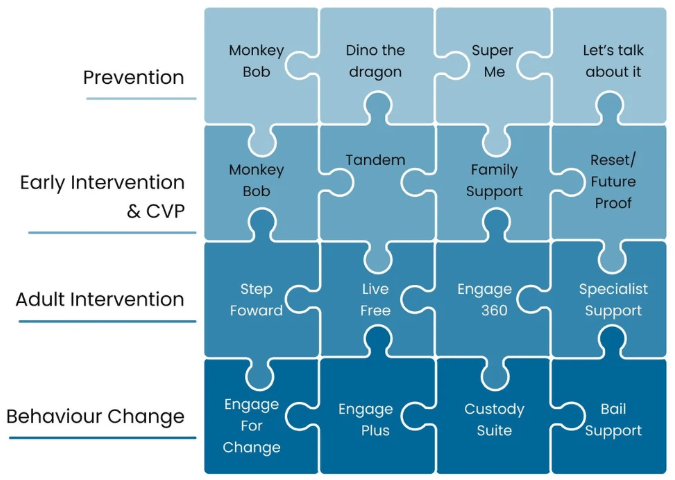
Shift the focus from adult and child victims to people with harmful behaviours
Prevention
Age appropriate education and awareness. Safety, emotional regulation and key skills from age 2 to 100 and for all communities.
Early Intervention
Children and young people displaying harmful behaviours. The first point of contact by health and social care professionals, criminal justice, education, employers and parents.
Intervention
Every contact trained to respond appropriately, equipped with common skills, able to ask the right questions in the right tone
Behaviour Change
High quality therapeutic support to change behaviour

Get In Touch
If you’d like to learn more about the Engage Approach and how it can support your organisation, we’re here to help.
Speak to our team to explore practical, effective solutions.